
My North Spirit Lake Adventure
Pueblo Science gave me the trip of a lifetime. I went to North Spirit Lake First Nation with a suitcase full of science experiments, ready to teach. Months after returning home, I am still thinking about everything I learned.
At Victoria Linklater Memorial School, our days were filled with curious questions, enthusiastic students, and plenty of laughter. To make Science Week fun and engaging, we brought science to life through exciting, hands-on experiments that encouraged students to explore, get creative, and learn by doing, something they especially loved!
With our Grade 7/8 students, we explored circuits, coding, and robotics, including building devices that could detect heart rates. We also introduced students to the microscopic world by collecting cheek cell samples and staining them with methylene blue to visualize the nuclei of their own cells under a microscope. Our Grade 5/6 students explored electricity in a different way, creating fruit batteries and learning how everyday materials can generate electrical energy. With the Grade 3/4 students, we dove into the science of buoyancy by building Cartesian divers, allowing students to see firsthand how changes in pressure can make objects sink or float. We also made bath bombs with the class, which quickly became such a hit that students across the entire school wanted to join in! For our youngest scientists in kindergarten and Grades 1/2, we explored the importance of handwashing through fun, interactive activities that demonstrated how easily germs can spread and how soap helps wash them away.
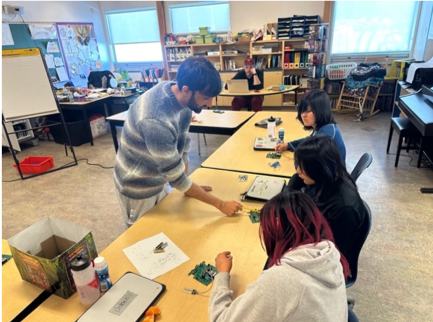
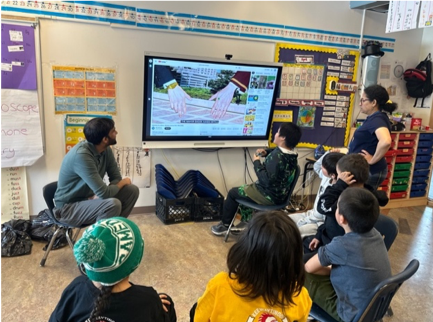
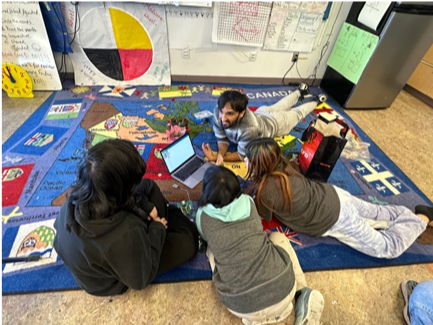
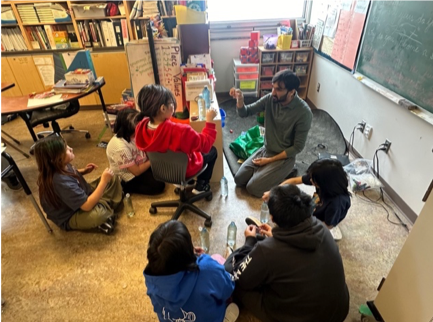
And then… there was the magnetic slime. A fan favourite across all grades… and a challenge for teachers and instructors alike! Across every grade, our goal was to make science more than just something students learn about in a classroom. We wanted them to experiment, ask questions, get their hands dirty, and discover just how exciting science can be!
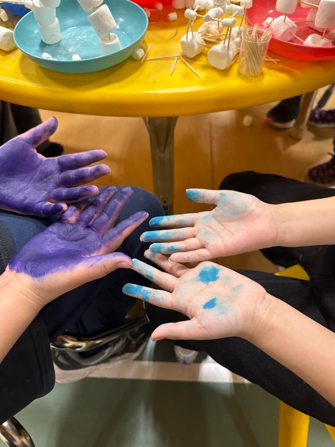
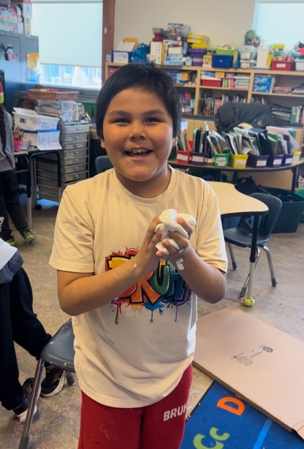
Figure 2. Think slime + food colouring… everywhere!
The experiments gave us opportunities to connect with students, share in their excitement, and encourage them to explore something new. But our learning extended well beyond the classroom, through the people who welcomed us and the conversations we shared.
To wrap up an exciting week of science, we hosted a community Science Festival at the school, inviting students, their families, and even community Elders to join in on the fun! With eight interactive stations, everyone had the opportunity to explore science firsthand, from experimenting with electricity and plasma balls to creating 3D holograms, testing heart rate monitors, and watching a vortex cannon in action. Some of the biggest hits were our bath bomb and perfume-making stations, where students, parents, and Elders could create something of their own to take home. It was especially heartwarming to see the excitement extend beyond the classroom, with families and Elders getting just as involved and curious as the students! The festival was a wonderful way to bring the school and community together, share what the students had been learning throughout the week, and remind everyone that science is something people of all ages can enjoy.
First, though, we had to get there….
Four flights and a little uncertainty
Hamzah (my fellow student and a director at Pueblo Science) and I began our journey at Billy Bishop Airport. Four flights, two nights in Thunder Bay, and several weather-related uncertainties later, we finally arrived in North Spirit Lake aboard a chartered plane carrying food supplies.
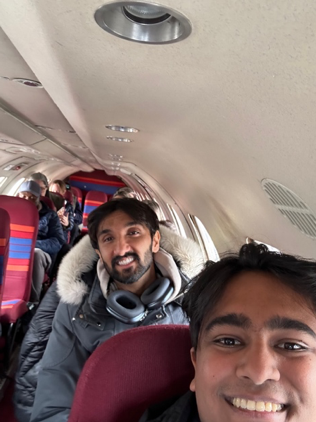
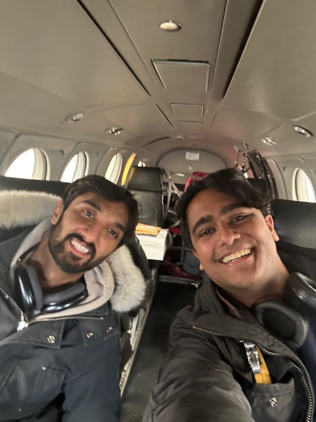
Figure 3. Many of our flights were on small planes carrying just 16–20 passengers. With rough weather in Northern Ontario, we were never quite sure whether the next flight would take off. Our final ride was on a chartered supply plane!
At the airstrip, we met Sujata and Anil, two teachers at Victoria Linklater Memorial School who generously hosted us during our stay. After the drive to their home near the school, we settled in and began preparing our experiments for the week. Our journey had already given us a small glimpse of how much weather and transportation could shape daily life in a fly-in community. During our stay, we began to understand more.
Conversations that stayed with me
One of the first things we were told was that we couldn’t drink the tap water. We also learned that many homes in the community did not have direct access to piped water. Supplies had to arrive by plane or along seasonal winter roads. In Toronto, I rarely think twice about turning on a tap for a glass of water or walking around the corner to pick up groceries. In North Spirit Lake, I became more aware of the infrastructure behind those everyday conveniences, and what it means when that infrastructure is inadequate or unavailable. It was difficult to reconcile how much I took for granted at home with the barriers people faced within the same province.
During our stay, we were fortunate to enjoy many wonderful home-cooked meals with Sujata and Anil, who were not only incredibly generous hosts but also amazing cooks! Some of my favourite memories from the trip were the evenings spent around the dinner table, sharing stories, laughing, and learning more about life in the community. One night we had the opportunity to share dinner with Elders from the community. They spoke about access to health care, the outpost nursing station, and the challenges of relying on visiting physicians. Listening to their experiences made me think about how differently access to care can look depending on where you live. The Elders also asked what we thought about traditional and Western medicine. After a few jokes about the spicy ingredients I had used in our version of Japanese curry, we spoke about the value of both and the importance of respecting traditional healing knowledge. That conversation has stayed with me. It reminded me how much we can learn by making time to listen and understand experiences beyond our own.
Jackfish, Jack pine, and Whiskyjacks
Of course, our time outside the classroom wasn’t all serious conversation. Between the teaching, teasing, and keeping up with the children, Hamzah and I also went ice fishing to catch some dinner!
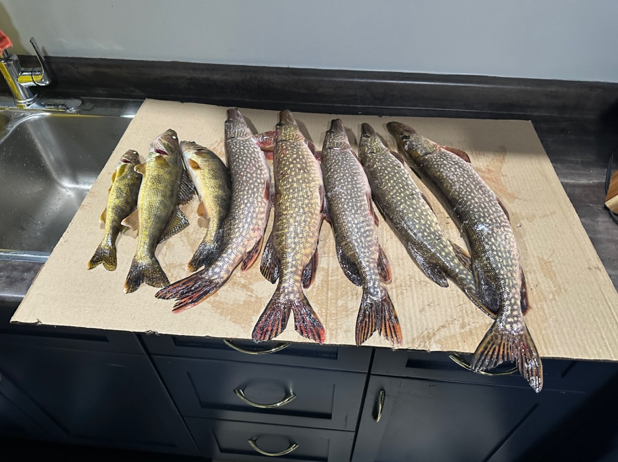
Figure 4. One day we caught 5 jackfish, or northern pike, and 3 walleye!
This led to another discovery: the trees around the home were jack pine, the bird scavenging in the snow was a whisky jack, and the fish in the lake were jackfish. Apparently, Jack was everywhere. These moments became as much a part of the trip as the experiments themselves! Preparing meals, spending time outdoors, and getting to know the people who had welcomed us had become ingrained into our daily routine at NSL.
What I brought home
When I think back to North Spirit Lake, I think of the students’ enthusiasm, the laughter in the classrooms, and the magnetic slime that probably travelled farther than we intended. I think of the teachers who opened their home to us and the Elders who shared their time and perspectives over dinner. I also think about the questions I brought home: about access to clean water and health care, about the assumptions I make living in Toronto, and about how I can carry what I learned into my research, teaching, and everyday life.
I am grateful for Pueblo Science and the opportunity to help advance science education in communities with limited resources. I am grateful to the students, teachers, and community members in North Spirit Lake who made this experience so memorable. I hope we left the students with new questions to explore and a little more excitement about science. They certainly left me with plenty to think about, and I can’t wait to return
We are grateful to Stefan Aguiar for writing this blog and for bringing fun science to students of Victoria Linklater Memorial School. We also thank NSERC Promo Science for supporting our STEM Enrichment in First Nation Communities Program.